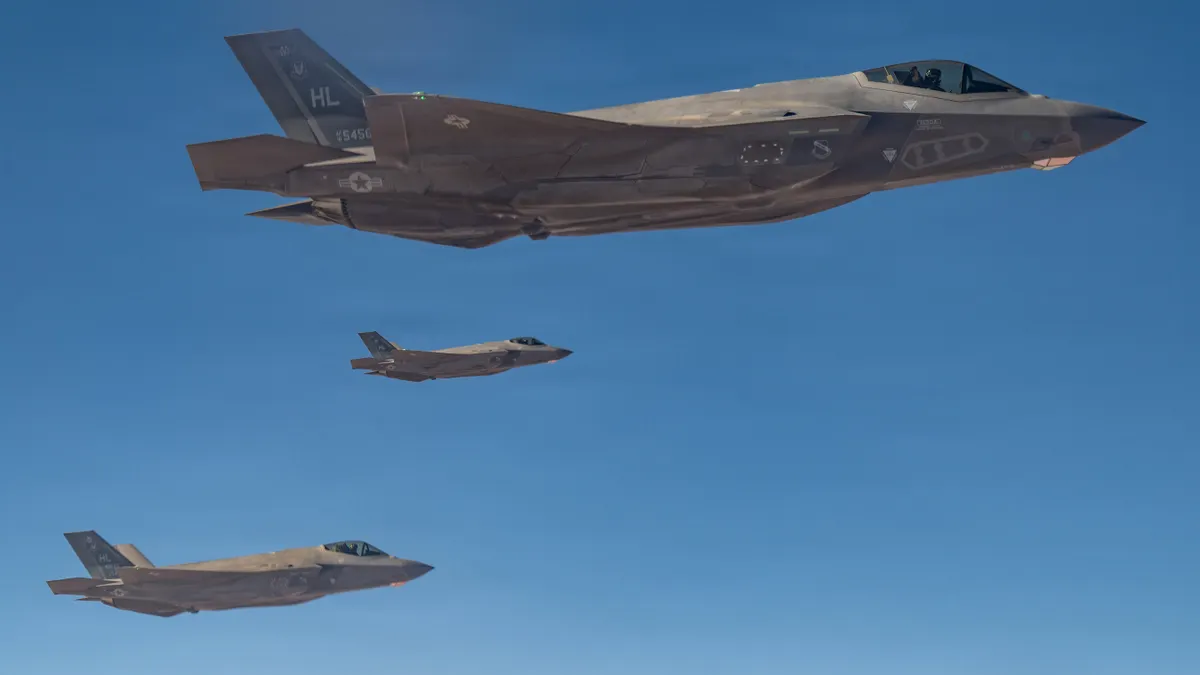
Lockheed Martin and the Pentagon reached an agreement announced Thursday in which the defense contractor will self-fund at least $7 billion in initiatives to bolster the agency’s F-35 Lightning II Joint Strike Fighter fleet.
The deal spans 10 years and includes orders for 850 U.S. fighter jets as well as “associated initial spares,” modification kits and maintenance, according to Lockheed’s press release. The contract also includes international customer orders at a continued production rate of 156 aircraft a year.
The partners aim to drive down unit prices and provide cost predictability for the U.S. government. Additionally, the contract would improve the workforce and supply chain issues in the defense industrial base as well as bolster readiness for F-35 customers worldwide by improving interoperability across U.S. allies’ fleets.
About 60% or more of the F-35 comes from Lockheed’s supply chain, CEO and Chairman James Taiclet said during an earnings call Thursday. Some of its suppliers are prominent companies, including Northrop Grumman, which produces the fighter jet’s center body, and U.K.-based BAE, which makes the jet’s aft body.
“We want them to have production stability just as we would like to have it, all the way down to the nuts and bolt suppliers [and] put it all together in our factory at Fort Worth, [Texas],” Taiclet said.
The deal would enable suppliers to have the “same concept” available to them to invest in their operations as well as hire enough people to improve their software systems, letting them have a “long enough” return on investment, the CEO added.
“Their performance improvements will flow through to us,” he said. “One of our biggest costs is supplier late or poor quality in all the inputs that come to us in the final assembly. So we will benefit from that.”
Even if yearly output remains at 156, the investments will lead to a “much healthier” production system for the defense industry and a “more predictable” production system for the U.S. government, Taiclet said
The funds will also enable Lockheed to input new capabilities and improve test capabilities for itself and its suppliers without risking price reductions in the future.
“We'll have faster modernization as a collective because of being able to do that,” Taiclet said.
Congress will have to approve the deal before it can be finalized, the agency said. The F-35 Lightning II program is part of the Pentagon’s $1.5 trillion proposal for fiscal year 2027, including a $21.4 billion request for the fighter jet project.
If approved, the deal would also help stabilize the F-35’s supply chain for bulk procurement of raw materials and critical parts, and it would reduce bottlenecks, according to the press release.
Despite the midterm elections looming, Taiclet said uncertainty around federal funding is not new for the defense industry. “Fiscal 2027 opened under a continuing resolution and the outcome of additional funding through reconciliation is still taking shape,” Taiclet said. “The demand for our capabilities, though, is driven by the threat. It has bipartisan support and is not tied to any one bill or election. The multiyear contract structure is built for this environment, and undefinitized contract actions let production start even when appropriations will take more time.”
If Congress decides to modify or cut short volume orders agreed upon, Lockheed has a recovery mechanism to get the investments back, Taiclet added.
The International Association of Machinists and Aerospace Workers union is also backing Lockheed’s deal and is urging Congress to pass legislation.
The F-35 supply chain includes 1,800 suppliers employing more than 254,000 people across 48 states and Puerto Rico, according to the Machinists’ website. Employees represented by IAM District 776 at Lockheed’s Fort Worth factory build the F-35. The union also represents workers at Pratt and Whitney’s facility in Connecticut, which manufactures the engine for the F-35.
“A 10-year commitment tells suppliers and workers that Washington is serious about this program,” IAM International President Brian Bryant said in a statement. “It protects good union jobs, saves taxpayers money and gets increased capability into the hands of our warfighters, faster. Congress should authorize it.”